Effective sales management is the key to sustainable competitive advantage. Our Full Potential approach is specifically designed to master the challenges of B2B sales and systematically tap into your full market potential
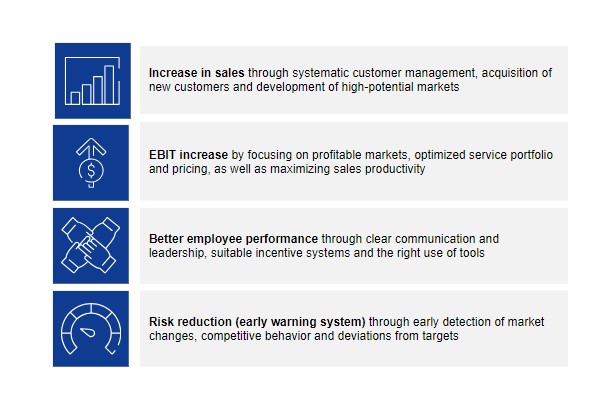
Four reasons why the full potential approach can pay off for your sales organization
Through our daily work with our customers, we know how easy it is to get caught up in the whirlwind of day-to-day business and lose sight of the systematic development of market potential. With the tried and tested Full Potential approach, we tackle the challenges in B2B sales together with you. In our past projects, we have already been able to support numerous clients in putting their company in the fast lane. This has resulted in four significant improvement potentials.
Helbling's Full Potential approach
Together with you, we will develop your full market potential in three phases and answer three key questions: Where to play, How to win and How to execute. Based on your individual needs, each phase can focus on different core topics
Where to play
Setting the right focus is the basis for successful market development. In this phase, we identify and prioritize the most attractive and profitable markets for you so that you can fully focus your limited resources on them. At the end of the phase, we will work with you to derive a sales ambition based on the potential identified. The Where to play phase can include the following core topics:
Focusing on your existing markets.
- Market analysis: In this step, we focus on identifying relevant market data such as market size, expected growth, trends, geographical distribution, etc. Our market analysts work with leading databases and market reports. Depending on the topic focus, engineers and technical experts from the Helbling Group are also involved in this step.
- Market prioritization: Based on the market analysis, the markets are prioritized in the next step. This is done using the two dimensions of market attractiveness and your “Ability-to-Win” per market. We use the “Ability-to-Win” to measure how well your company is positioned to exploit the potential in this market. The end result is a clear target picture of which markets promise the greatest success and where resources should be focused.
- Consideration of new applications and markets: You may be asking yourself how you can use your products and expertise to tap into profitable markets outside your core business. We are also happy to support you in expanding into new applications and markets.
- Core competencies: We work with you to develop your core competencies and key differentiators from the competition. This forms the basis for identifying and prioritizing new applications and markets.
- Identification of new potential applications and markets: New applications and markets are identified that have a high degree of correlation with your core competencies. These are then evaluated and prioritized in the same way as in steps 1.1 and 1.2.
- Value proposition: Dedicated value propositions should be drawn up for the prioritized markets. The unique selling proposition and the raison d'être for your offering should be clearly formulated and recorded. This is an eminently important tool for sales in order to address potential target customers in a targeted manner in phase 2.
How to win
Once we have worked out your focus, the second phase is about how you can best develop your focus markets. We concentrate on three core topics.
- Ecosystem, stakeholders and target customers: In an ecosystem, all relevant stakeholders and selected target customers are defined for each focus market. This documents the market mechanics, how the individual stakeholders interact and who makes the purchasing decision or can influence it.
- Customer portfolios: The customer portfolio structures your existing customer base and potential new customers. Each opportunity is clearly assigned to a sales employee. The customers are then prioritized and segmented according to their potential. Clear targets can then be formulated for each customer segment and suitable support measures defined.
- Pipeline, value selling and increasing the hit rate: Suitable measures for more efficient lead generation and increasing the hit rate are identified. Sales staff can be provided with specific tools and guidelines (e.g. value selling) to make the best use of their time with the customer.
How to execute
In the third phase, your organization and processes are optimized and geared towards achieving your goals.
- Development of the sales organization: We work with you to develop a target image of your future sales organization. This includes the required structures, responsibilities, resources, profiles, sales channels and partnerships. If necessary, we will also derive measures based on an activity analysis so that the sales force is relieved and can maximize its time on site with the customer
- Data, tools and digital channels: Relevant KPIs will be derived according to your goals in order to make your success measurable and visualize it for everyone. Furthermore, relevant digital tools should be optimized for your sales. This may also include an expansion of your CRM system.
- Transformation and change: Changing an entire sales organization and established processes is challenging and requires excellent planning and communication. We are happy to support you with our many years of experience in transformation and change.
- Business case and implementation planning: A well-founded business case underpins the added value of the measures defined in the course of the “Full Potential” project. A structured schedule with deadlines and responsibilities should also be drawn up to ensure successful implementation.
Welchen Nutzen bringt der Full Potential in Industrial Sales Ansatz?
- Mehr Umsatz durch systematisches Kundenmanagement, Neukundengewinnung und die Entwicklung potenzialstarker Märkte.
- Höherer EBIT durch Fokus auf profitable Märkte, ein optimiertes Serviceportfolio, klare Preisstrategie und maximierte Vertriebsproduktivität.
- Bessere Mitarbeiterleistung durch klare Führung, passende Anreizsysteme und den richtigen Einsatz von Tools.
- Reduziertes Risiko dank Frühwarnsystem, das Marktveränderungen und Zielabweichungen frühzeitig erkennt.
- Optimierter Aftermarket-Service durch digitale Plattformen und Transparenz über die Installed Base (as planned, as built und as maintained) mit besserer Ersatzteilverfügbarkeit und geringeren Garantiekosten.
- Massgeschneiderte Empfehlungen für Ihre Industrie dank tiefem technischem Produktverständnis der Helbling Gruppe.
So erzielen Sie messbare Leistungssteigerungen über Vertrieb, Service und Aftersales hinweg und beschleunigen profitables Wachstum.
FAQ als FAQPage - FAQ-Schema (JSON-LD)
Was ist eine Vertriebsstrategie im B2B-Industrievertrieb?
Eine Vertriebsstrategie im B2B-Industrievertrieb legt fest, in welchen Märkten und bei welchen Kunden ein Industrieunternehmen wächst, mit welchem Angebot es gewinnt und wie es seinen Vertrieb dafür organisiert. Sie umfasst die Priorisierung attraktiver Marktsegmente, eine differenzierte Value Proposition, die passende Preis- und Servicestrategie sowie die Verankerung in Vertriebsprozessen, Organisation und CRM. Im Unterschied zum B2C-Vertrieb berücksichtigt sie längere Verkaufszyklen, mehrere Entscheider (Buying Center) und erklärungsbedürftige technische Produkte.
Für welche Unternehmen eignet sich der Full Potential in Industrial Sales Ansatz?
Der Full Potential in Industrial Sales Ansatz eignet sich für B2B-Industrieunternehmen, etwa aus Maschinen- und Anlagenbau, Medizintechnik, Elektronikindustrie, Bauzulieferung, Komponentenfertigung und industrienahen Dienstleistungen. Er ist besonders wertvoll für Unternehmen, die ihre Marktdurchdringung erhöhen, neue Marktsegmente erschliessen oder ihre Vertriebsorganisation gezielt weiterentwickeln wollen.
Was ist der Share of Wallet?
Der Share of Wallet ist der Anteil am gesamten Einkaufsvolumen eines Kunden für eine Produktkategorie, den ein Anbieter auf sich vereint. Ein tiefer Share of Wallet deutet oftmals auf ein ungenutztes Wachstumspotenzial bei bestehenden Kunden hin.
Was ist ein Target Operating Model (TOM) im Vertrieb?
Ein Target Operating Model beschreibt, wie ein Vertrieb organisatorisch und digital aufgestellt ist. Das physische TOM umfasst Organisation, Rollen, Profile und Ressourcen, das digitale TOM umfasst CRM, Webshop, Produktkonfigurator, PLM, ERP und MES und beschreibt wie Systeme und Daten zusammenhängen.
Was ist Value Selling?
Value Selling ist eine Verkaufsmethode, bei der nicht das Produkt, sondern der messbare Kundennutzen im Zentrum des Verkaufsgesprächs steht. Das erhöht die Trefferquote im Vertrieb.
Wie lange dauert ein Full Potential in Industrial Sales Projekt?
Ein Full Potential in Industrial Sales Projekt gliedert sich in die drei Phasen Where to Play, How to Win und How to Execute. Jede Phase dauert typischerweise rund 4-6 Wochen, sodass ein vollständiges Projekt etwa 3-5 Monate umfasst. Der genaue Zeitrahmen richtet sich nach Umfang und Zielsetzung des jeweiligen Unternehmens.
Können die drei Phasen einzeln durchgeführt werden?
Ja. Die drei Phasen Where to Play, How to Win und How to Execute bauen aufeinander auf, lassen sich aber auch einzeln durchführen. So kann ein Unternehmen zum Beispiel mit der Marktpriorisierung (Where to Play) starten oder gezielt die Umsetzung (How to Execute) angehen, wenn Strategie und Zielmärkte bereits definiert sind.
Was unterscheidet den Full Potential in Industrial Sales Ansatz von klassischer Vertriebsberatung?
Der Full Potential in Industrial Sales verbindet Strategie und Umsetzung in einem durchgängigen Vorgehen: Von der Marktpriorisierung über die Vertriebsstrategie bis zur Verankerung in Organisation, Prozessen und CRM. Er kombiniert dabei technische Industrieexpertise mit datenbasierten und digitalen Methoden, statt nur strategische Empfehlungen zu liefern. Der entscheidende Unterschied: Helbling verbindet Vertriebsberatung mit echtem Ingenieur-Know-how. Dieses technische Produktverständnis erlaubt eine fundierte Bewertung von Produkten, Anwendungen und Zielkunden, die reine Strategieberatungen nicht leisten können.
Welche Ergebnisse lassen sich mit dem Full Potential in Industrial Sales erzielen?
Der Full Potential in Industrial Sales führt zu mehr Umsatz, höherem EBIT, besserer Mitarbeiterleistung und reduziertem Risiko. Er steigert die Zahl hochwertiger Leads, erhöht die Trefferquote im Vertrieb und ermöglicht profitables Wachstum in den margenstärksten Märkten, Kunden und Produkten.
Liefert Helbling nur eine Strategie oder auch die Umsetzung?
Helbling liefert beides. Der Full Potential in Industrial Sales Ansatz endet nicht mit einem Strategiepapier: Wir begleiten Industrieunternehmen aktiv bei der Umsetzung, von der Gestaltung der Vertriebsprozesse über die Einführung von CRM- und Sales-Tools bis zu Training und Value Selling. Diese konsequente Umsetzungsorientierung ist einer der zentralen Vorteile von Helbling.
Was ist der Unterschied zwischen Vertriebsstrategie und Vertriebsoptimierung?
Eine Vertriebsstrategie legt fest, in welchen Märkten und bei welchen Kunden ein Unternehmen wächst und mit welchem Angebot es gewinnt. Die Vertriebsoptimierung verbessert die operative Umsetzung, also Prozesse, Tools und die Leistung der Vertriebsorganisation. Der Full Potential in Industrial Sales Ansatz verbindet beides in einem durchgängigen Vorgehen.
Wie starte ich ein Full Potential in Industrial Sales Projekt mit Helbling?
Ein Full Potential in Industrial Sales Projekt beginnt mit einem unverbindlichen Erstgespräch, in dem die wichtigsten Stellhebel Ihres Vertriebs gemeinsam identifiziert werden. Auf dieser Basis wird das passende Vorgehen definiert, entweder als vollständiges Projekt über alle drei Phasen oder fokussiert auf einzelne Phasen.